By problem · Compliance and ISO 50001
Are you obliged, and is your evidence ready?
Once the threshold for appointing an energy manager is crossed, annual reporting and monitoring duties begin; an ISO 50001 audit asks for evidence. GenieBlocks produces consumption, the baseline and reports from the same metered data.
Short answer
Consumption, the baseline and reports are prepared from the same metered data. ISO 50001 outputs (EnPI, audit evidence) are on the roadmap.
Today and on GenieBlocks
| Today | On GenieBlocks |
|---|---|
| Whether the facility is obliged stays unclear, because floor area and consumption sit in different places. | Measurement points feed the same data backbone; missing and faulty data is flagged. The thresholds are in the regulation section below. |
| The annual submission and internal reports are compiled by hand from different spreadsheets. | The energy baseline and scheduled reports are prepared from the same data and exported. |
| Audit evidence is scattered; baseline, improvements and metering records live apart. | Metering, reports and improvement records are on the same platform. EnPI and audit-evidence outputs are not available yet; they are on the roadmap. |
How we solve it
We gather consumption in one source
All measurement points feed the same data backbone; missing and faulty data is flagged.
We produce the baseline and reports
The energy baseline and scheduled reports are prepared from the same data and exported.
We keep the evidence in one place
Metering, reports and improvement records are on the same platform. ISO 50001 outputs (EnPI, audit evidence) are on the roadmap.
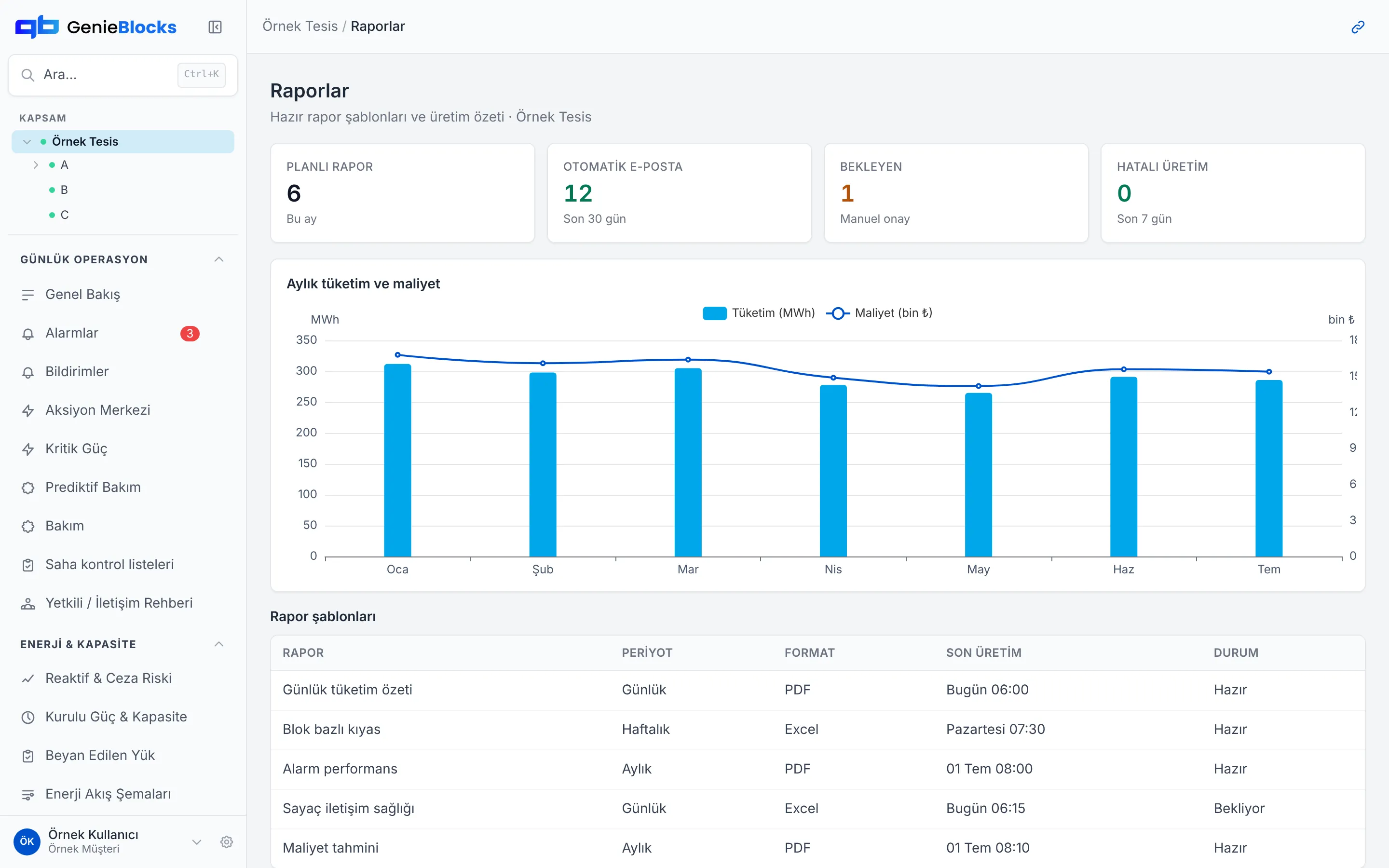
How the platform addresses them
The modules that map to these problems. All modules run on one data backbone, in the same interface.
Reports
Ready-made energy reports.
Energy Baseline
Deviation of consumption from the baseline period.
Data Quality
Tracking of missing data and offline meters.
Metering Points
Catalogue of meters and metering points.
Savings Score
Savings score and targets.
Related capabilities
Items marked coming soon are in development. Timing and scope may change; this is not a commitment.
ISO 50001 outputs (EnPI, baseline, audit evidence)
Coming soon
Regulation
An industrial operation appoints an energy manager when annual consumption is 1,000 toe or more. For commercial and service buildings the threshold is a total construction area of at least 20,000 m² or 500 toe a year; for public buildings, under article 9 of the regulation, at least 10,000 m² or 250 toe a year. Obliged parties submit their energy consumption data to the Ministry by the end of March each year.
- Official source: Energy Efficiency Law No. 5627 (Ministry of Energy and Natural Resources)
- Official source: Regulation on Increasing Efficiency in the Use of Energy Resources and Energy (mevzuat.gov.tr)
Last checked:
This content is not legal advice.
Energy regulation calendar
The dates come from the official texts. Which row applies depends on the facility.
End of March, every year
Consumption notification
Public buildings, commercial and service buildings, industrial facilities, power plants and organised industrial zones enter their notifications, in the format set by the Ministry, on the ENVER portal by the end of March each year.
Source: Regulation on Increasing Efficiency in the Use of Energy Resources and Energy, article 32 (mevzuat.gov.tr, in Turkish)Guide
30 April, every year
Verified emissions report
An operator of an Annex-1 activity reports the previous calendar year’s greenhouse gas emissions and activity levels to the Climate Change Presidency by 30 April each year. The report is verified before it is submitted. The Presidency may extend the deadline by up to one month. A facility in the Emissions Trading System surrenders allowances by the last business day of November in the compliance year.
Meter-reading period
Reactive energy
The reactive limit applies to the meter-reading period. The first breach in a calendar year is shown on the bill and deducted on that same bill. If the reading runs longer than 35 days, the charge is limited to 35 days.
Source: Procedures and principles for electricity market tariffs, article 13 (EPDK, in Turkish)Guide
Every four or seven years
Energy audit
An industrial facility with annual energy consumption of 1,000 toe or more renews its audit every four years. Commercial and service buildings with a total construction area above 20,000 m², or annual energy consumption above 500 toe, renew it every seven years. Public buildings that must appoint an energy manager renew it every seven years. The final audit report goes to the Ministry by the end of March of the year after the audit.
Go to Regulation and compliance
Last checked:
This content is not legal advice.
Common questions
Does this page tell me whether I am obliged?
No. The thresholds stay in the regulation section, with the official source. The decision uses the facility’s own data.
Does an ISO 50001 audit pack come out today?
No. EnPI, a baseline export and audit evidence are on the roadmap. Today, consumption, the baseline and reports are prepared from the same metered data.
Where do the reports come from?
Scheduled reports are produced from metered data. You do not assemble spreadsheets by hand.
Let’s talk about your facility
Join the early access list; in the demo we show the platform and work out together how to start with the meters and systems you already have.